
JULY 23, 2026, marks the 10-year anniversary of an event that continues to have a profound impact on my life. On Saturday, July 23, 2016, as we drove to a local community concert, my husband turned to me and asked a question that referenced me as an infant, mentioned an undisclosed-location doorstep, and queried my knowledge of said doorstep as it related to my birth.
I can imagine my expression as I half heard him continue, citing a newspaper article and a drop-in visit from my mom that afternoon while I was out. When we walked inside the house after the concert, he handed me a copy of the news clipping from the November 20, 1963, issue of the Angola Herald and said, “Call your mom.”
A casual conversation between grandmother (Mom) and granddaughter (my daughter) on the previous Thursday had piqued my internet-savvy daughter’s curiosity. Later that day, a 15-minute online search produced the front-page newspaper article. While all involved knew I’d been adopted, only my parents were privy to the found-on-a-doorstep detail. A truth they admittedly never intended to keep secret, but neither did they formulate a plan to reveal the small but significant detail. Because, as Mom insisted, “You do not tell a small child that someone abandoned her on a doorstep.” An assertion I agreed with at the time and still agree with a decade down the road.
Ten years later . . .
As the 10th anniversary of this day neared, reflection and nostalgia swirled through my mind. At this juncture, I can’t even imagine not knowing the who and the where and a bit of the how concerning my birth story. And those I’m-so-glad-I-know thoughts and feelings never fail to remind me that much of this “knowing” hinged on the curiosity and persistence of someone I would come to know as Aunt Donna.
While the maternal family tree branches fell into place quickly thanks to a first-cousin-once-removed (1c1r) level DNA match coupled with info from the 1963 Angola City Directory, the paternal branches refused to graft onto the tree. Although I still logged in daily to check for new matches, my hope of solving the father part of the equation had dwindled. And then on Tuesday, February 21, 2017, I received a message from new a DNA match, “I would love to hear from you! Call Donna at . . . ”
With a few clicks, we determined this “close family” match connected to my birth father’s side— the side that, up to this point, hadn’t shown matches closer than a third cousin. In a nerve-wracking (for me) phone call with my very excited new relative, it took mere minutes to conclude that I was Donna’s niece, having eliminated the possibility of being her grandchild or half-sister. Once we established that her brother attended college in Angola from 1961–1963, an aunt/niece relationship fit both the DNA results and the who-was-where-when facts.
The mystery of who my birth father was might have remained unsolved for who knows how long if not for an Ancestry DNA commercial that aired in Pennsylvania in 2016. After the advertisement streamed across the screen, Aunt Donna announced to her daughter, Honey, that she would like to test her DNA. Recent retirement had allowed her time to delve into family history, so why not test her DNA, she reasoned in that moment. Honey secretly filed away the casual, first-time-mentioned comment and purchased the Ancestry kit for her mom for Christmas 2016.
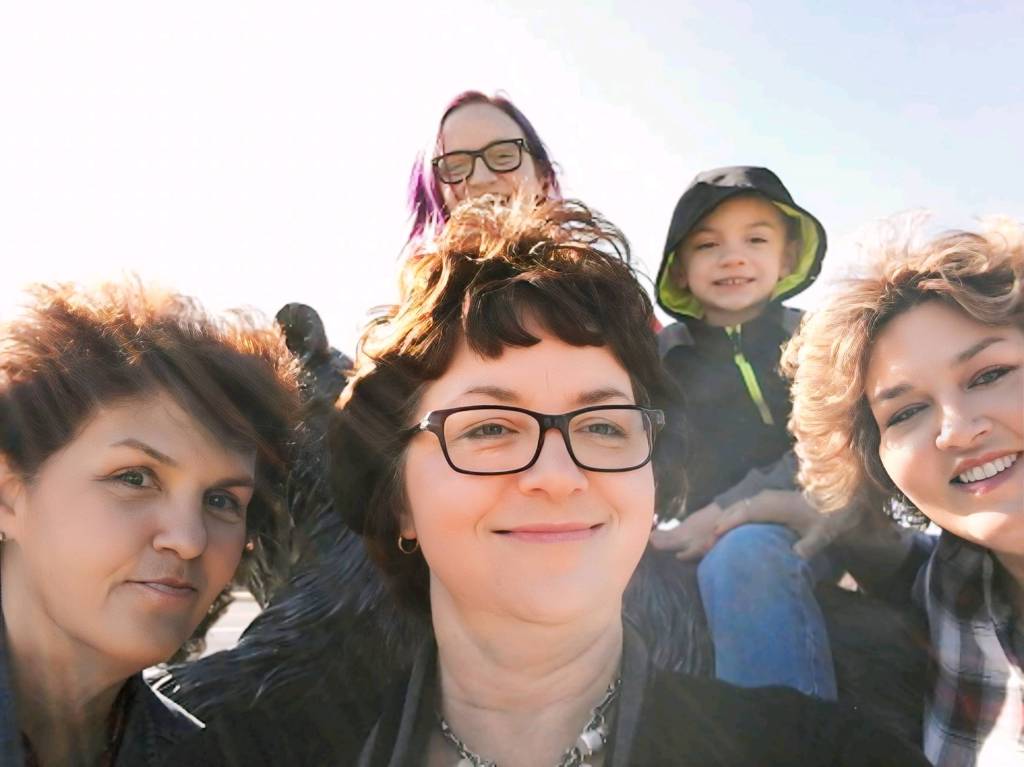
Aunt Donna and her daughter Honey journeyed from Pennsylvania so we could be together for my birthday in November 2017. We spent a very special day in Angola visiting the house whose backstep I’d been found on, peering from across the street at the house where my mother and brothers had lived in 1963, and touring the cemetery where my mother and grandparents were buried. Back home, we posed for a photo before a celebration supper. TOP Row: (l-r) daughter Jenna and grandson Dylan; BOTTOM Row (l-r) Aunt Donna, Beth, and cousin Honey
Aunt Donna welcomed me and mine to the family while enthusiastically immersing herself in the building of her Brown – Tobey family tree. She quickly became adept at interpreting her DNA results as she sorted through her matches, looking for evidence of other “surprise” family members. You see, Aunt Donna had long accepted the “it is what it is” philosophy, the same sentiment that had helped me reconcile with the complicated nature of my own discoveries. The bottom line: Donna and her full siblings potentially had multiple half-siblings out there somewhere, according to a reliable source who shared a few details that aligned with the known dalliances of her father, Clyde Brown.
Some have dubbed 2017 the “year that DNA testing blew up,” which meant Aunt Donna was blessed with an ever-increasing number of matches to organize and assign to a place on her family tree that already boasted nearly 900 people. It wasn’t long before she identified a younger half-sister, Susan, via a match to Susan’s son Daniel. Susan grew up with clues about who her father was, hints that fit Clyde spot on. And, eighteen months later, a second younger half-sibling, Raymond, appeared on the family radar via his daughter Jamie’s DNA match. Connecting with Donna brought answers to both Susan and Raymond’s families and added more kin to the Brown branches of our family tree. Believe it or not, neither of these “surprise” children fathered by Clyde fit the specific scenario of the rumored siblings. So . . . Aunt Donna and I will continue the search for those (or other!) siblings to her and aunts/uncles to me.
She also hoped to gain answers for another mystery also involving her father Clyde. Born in 1921 to Doris Brown who was unmarried, Clyde was raised mostly by his maternal grandparents Frank P. and Alice S. (Carter) Brown. As a child, Donna somehow recognized the situation for what it was, and she questioned, “Who was dad’s dad?” Her persistence and curiosity were rewarded with a name—Sam Bridges—that she quietly held onto for decades.
Even before discovering half-sis Susan, Donna pieced together a direct DNA-match-path to Samuel Sevy Bridges. She unearthed Clyde’s birth certificate to find the name Samuel S. Bridges typed in the “Father’s Name” blank. However, the “Child’s Name” blank appeared to have been filled in later with just one word etched faintly in pen or pencil, Brown, his mother’s maiden name. The written letters Illeg appeared across the top of the birth certificate, labeling the child as illegitimate.
Donna learned that Sam, who passed in 1982, he was not known to have ever married or had children. Questions filled with surprise, intrigue, and curiosity spilled from Sam’s niece Tisha and nephew Berry who well remembered their mother’s much older brother. They welcomed connecting with any and all of the Browns who had an interest, continuing to marvel at the large clan who unbeknownst to them began with their kind, hard-working uncle.
In July 2019, on our second visit to Maine, we lunched with Tisha, her husband Allen, daughter Lisa and her husband Joel, and my half-brother Alan (who lives in Maine) at a diner in the tiny town of Unity, Maine. Two years post the revelation of this “wow” discovery, Tisha and family still grappled with the reality that their Uncle Sam had descendants too numerous for them to count.
While chatting over sandwiches and French fry baskets, the conversation turned to exactly how we all connected. Alan and I explained that Tisha was mine and Alan’s first cousin twice removed (1c2r) because she was a first cousin to our grandfather Clyde. We were greeted with polite, vague nods. We further illustrated the connection by noting that Lisa was a second cousin once removed (2c1r) to me and Alan. Their “If you say so . . . ” and “We’ll take your word for it!” responses were accompanied by shaking heads and giggles that morphed into hearty laughter.
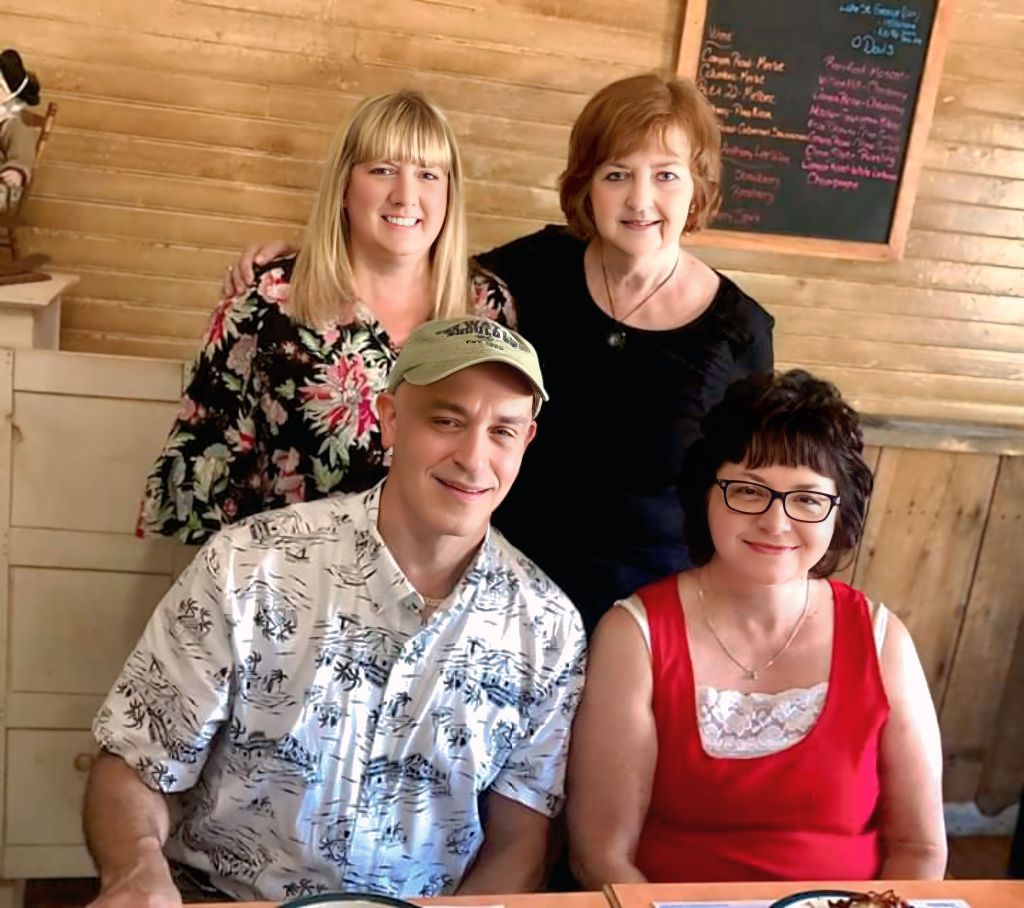
In 2019, we made the first in-person connection with kin who knew and remembered Sam Bridges. What a memorable afternoon we spent at Mammie’s Country Kitchen, catching up and getting acquainted with our new relatives.
TOP row (l-r) Lisa (2c1r) with her mother Tisha (1c2r); BOTTOM row (l-r) half-bro Alan who early on asked if we could “drop the half” and Beth
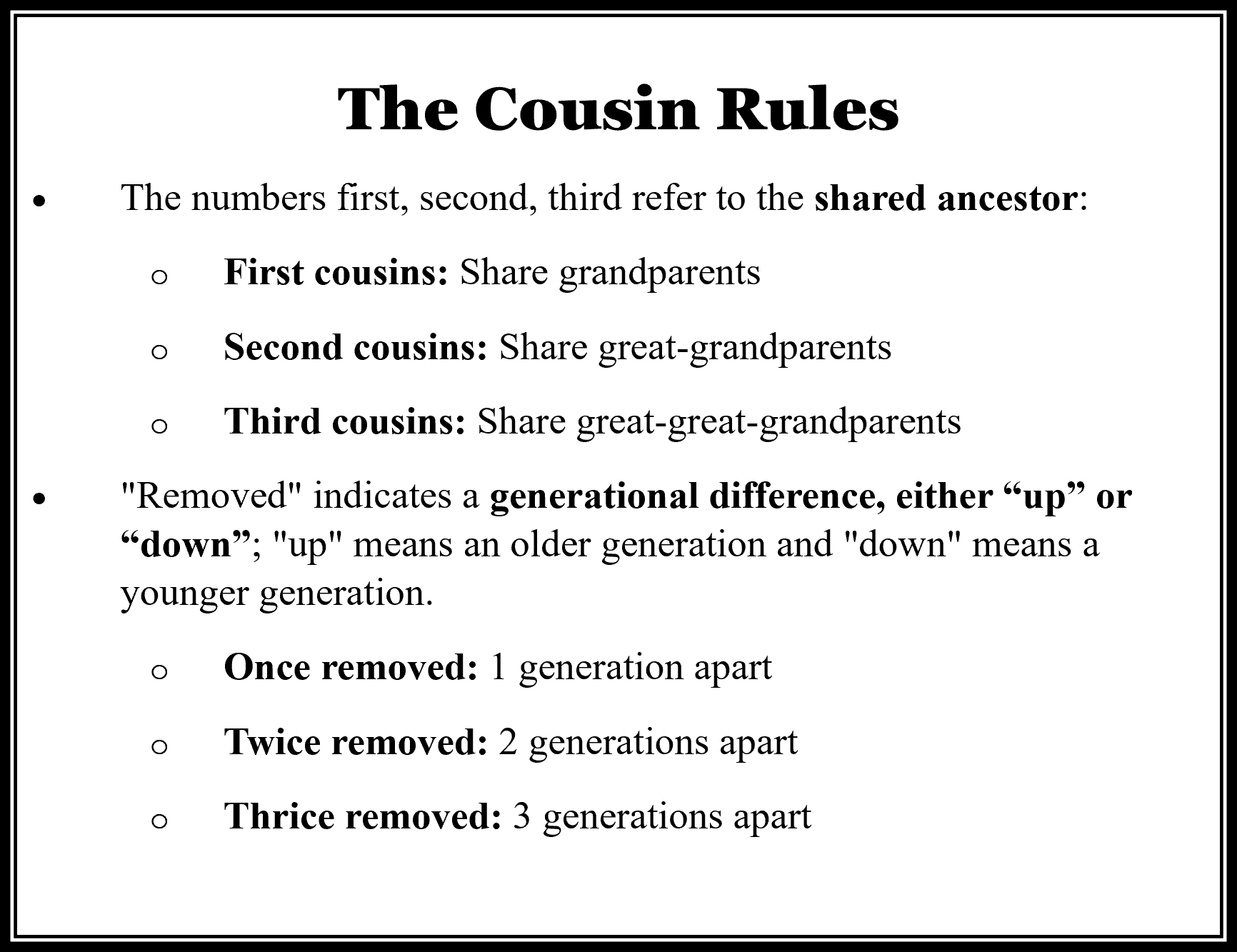
We’d had no choice but to tackle and master the tricky concept of “removed” cousins early on. The visual of a family tree helped us grasp the theory that “removed” refers to a generational difference from the shared ancestor—a parent, a grandparent, a great-grandparent. I remember the day I determined that a new match, Nicole K., connected as a second cousin twice removed (2c2r) on my mother’s maternal side. Nice. But when a match named Virginia reached out, asking how we were related, it took a bit to figure out that we were half third cousins twice removed (½ 3c2r) on my father’s father’s maternal side. Too fun.
My birth father Ron, Donna’s older-by-five-years brother, had no recollection of conversations about their father’s parentage. “Back in the day, such things were not customarily explained to kids—who of course didn’t know to ask,” he noted. He didn’t recall ever hearing the name Sam Bridges. Although he never donned a sleuthing hat—or tested his DNA—his engineering brain accepted the science without question.
Aunt Donna and I kept him apprised of each new family discovery. Not being the chatty type and known to be overly reserved when it came to displaying emotion, he was often difficult to read. Yet he seemed genuinely intrigued when I showed him my list of matches, noting who each of the top twenty or so were and how we connected, i.e., second cousin, first cousin twice removed, etc. He did seem pleased when we noted he shared a resemblance to his paternal grandfather, Sam.
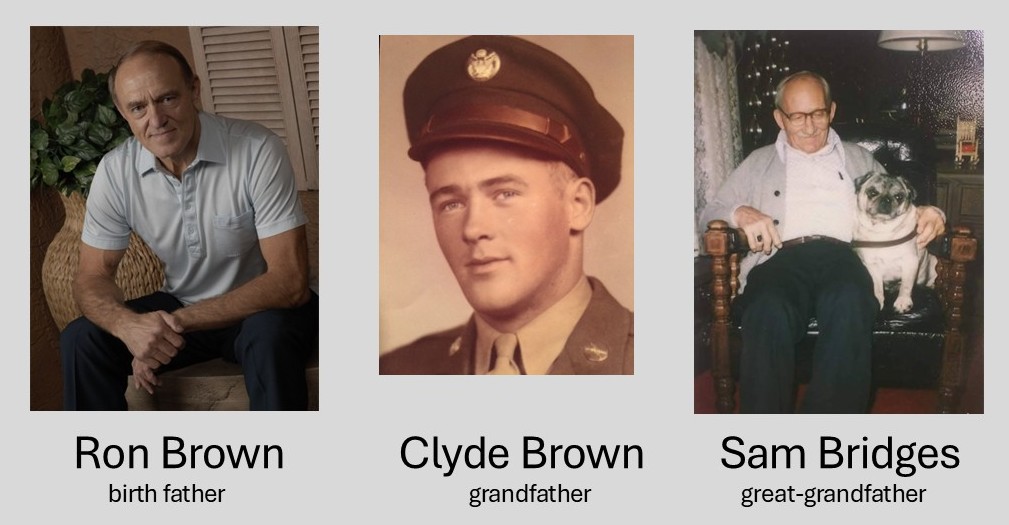
I never tire of looking for likenesses between folks who share DNA. Too bad these three generations of men never had the opportunity to be in the same place at the same time.
Paying it forward
Even as the pieces were falling into place for me—thanks to Aunt Donna—we’d already applied our budding skillset to other mysteries within our extended family. Soon, we began tackling cases for strangers, mostly adoptees, that we encountered through a variety of sources. Each mystery solved further enamored us with this technology that can barrel through decades-old mysteries, secrets, falsehoods, and rumors.
The secret to the success of genetic genealogy is that DNA doesn’t lie or otherwise spare the truth. Unlike people who can be swayed and/or driven by well-meaning or self-seeking motives, DNA bares the truth that sealed adoption records or redacted court documents attempt to erase, and it uncovers realities that faded memories or the passage of time have obscured.
I’ve lost count of how many “cases” I’ve worked on during this past decade. I’m guessing 50ish or so. I’m never so content as when I’m knee-deep in a search that can only be unlocked by the power of DNA results. I’m anxious to tackle new challenges and hopeful that some of the cases that remain stubbornly-unsolved will be wrangled to a conclusion in the coming days. Here’s to ten more (at least!) years of helping folks find answers to genetic questions.
 Beth Steury, Author