
Mid-summer found this DNA sleuth tackling a first-for-me challenge, involving Karrie, her adopted mother, and a monumental revelation.
Karrie’s mother Judy who’d been adopted as a ten-month-old infant, died in 1975, decades before direct-to-consumer (DTC) DNA testing offered adoptees a path to identify their “first” family. She died longing for information about her biological parents. These many years later, that longing still lives within Karrie, so at the age of 69, she took a DNA test.
I connected with Karrie a few weeks after her Ancestry results delivered a life-altering discovery. She was 50% Ashkenazi Jewish. She knew her father’s ancestry well enough to know that this revelation meant that her mom was 100% Jewish. Presumably born in Baltimore in March of 1931, Judy was adopted in January of 1932 by a couple of German descent with a long-standing familial association with the Lutheran church.
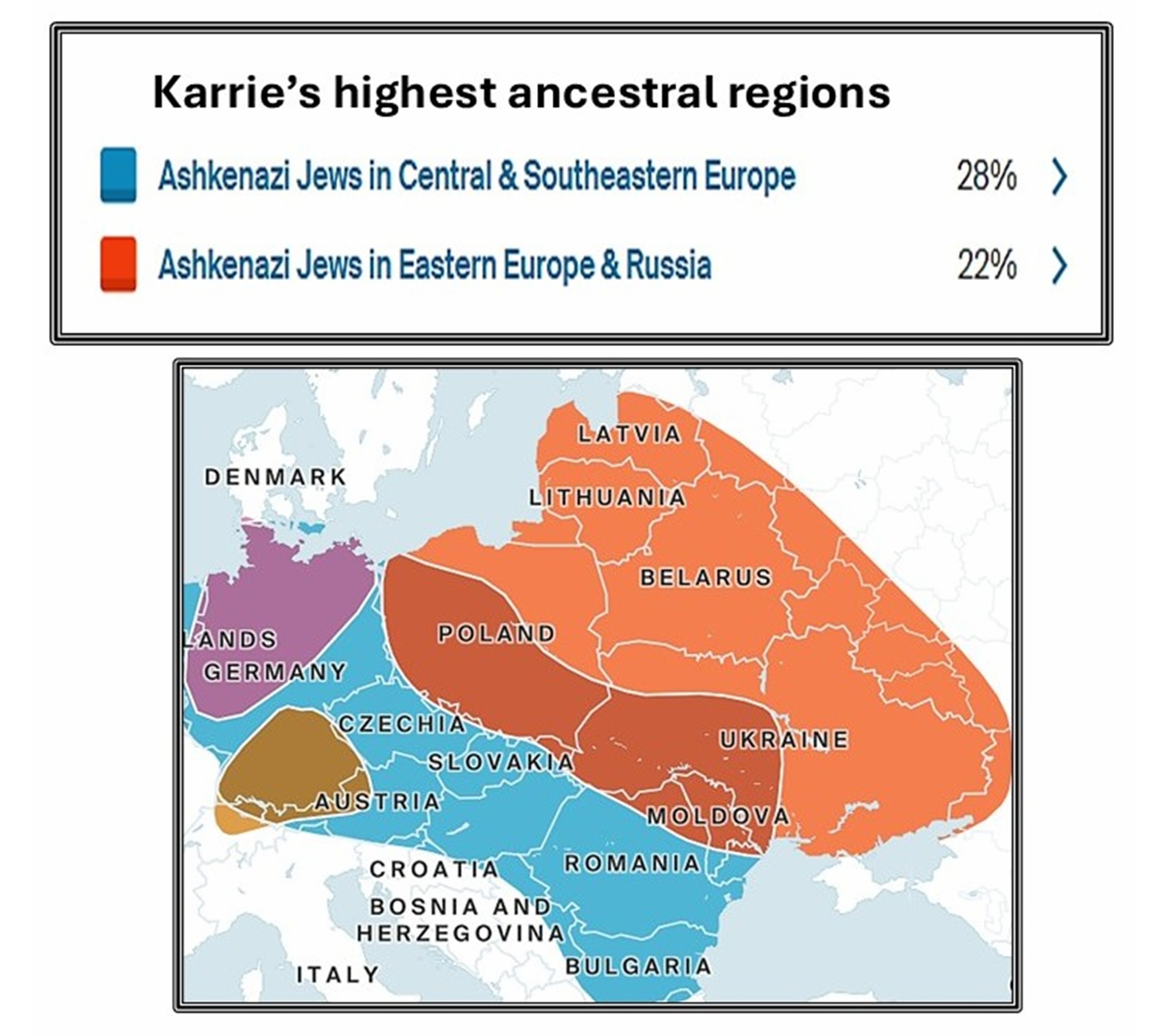
As Karrie and I messaged back and forth, I felt her shock and could imagine her somber expression and the slow motion of her head shaking in disbelief, still, a month after receiving the results. “We were raised Lutheran,” Karrie shared, “Because Mom was raised Lutheran.”
I’d not previously worked with DNA results that included a sizable chunk of Jewish ethnicity, but I was both willing to give it a go and excited for the opportunity. I’d known people who had unexpectedly discovered Jewish roots and witnessed the impact of such news that, for some, caused a near-tsunami-like wave that battered their identity. Karrie had always wondered about her mother’s parentage, but that desire morphed into a need when she learned of mom’s Jewish heritage.
Working with Jewish ancestry presents unique hurdles driven by a number of factors, including—
- Generations of people marrying within localized communities which in turn . . .
- Causes difficulty isolating which specific great-grandparent line a shared DNA match connects to because multiple ancestors trace back to the same small shtetl or region.
- Missing paper trails due to the destruction of European vital records during the Holocaust, combined with shifting national borders and the closed archives of the former Russian Empire,
- The not uncommon practice of “anglicizing names”—the process of changing non-English personal or family names to match English spelling and pronunciation, or by swapping them for an equivalent English name, or choosing entirely new names upon immigration. Examples: Klebanovich/Klebanowich became Kleb and Lazevnick became Lee.
The one piece of paperwork linked to Judy’s adoption was labeled an Ex Parte. Another first as I’d never heard the term. I learned an Ex Parte signified a legal proceeding brought for the benefit of only one party—the adoptive parents—with an assumption that the biological parents’ rights had already been entirely terminated or were legally non-existent in this action. This document referred to Judy as the infant Helen Patrick.
I hit the ground running, pleased with the level of DNA matches Karrie had, the highest being a half-aunt, great aunt, OR 1st cousin named Genie. Genie was either Judy’s half-sister, grandmother, full aunt, or full niece. The math didn’t compute for a grandmother relationship with Genie being 80 and Judy, if living, would have been 95. We suspected Genie to be Judy’s half-sister but didn’t rule out either niece or aunt. But on Judy’s maternal or paternal side? That’s always the big question when working with an adoption scenario where both parents are unknown.
It was no surprise that the same surnames swirled to a dizzying degree throughout the family tree connecting Karrie’s DNA matches. Without sharing all the painful details, suffice it to say that I lost several days following the wrong Weiner line because Genie’s mother’s maiden name was the same as her paternal grandmother’s maiden name. I should have been further researching the paternal granny’s ancestors and descendants rather than Genie’s mom’s family. Ugh. I apologized for the misstep, adjusted course, and was pleased to see that now several matches fell quickly into a logical place on the family tree. But nothing linked to a Helen, a Helen Patrick, or anyone with the surname Patrick. My guess is that wherever she was those first 10 months, her caretakers “assigned” her that name. Like I was “assigned” the name Susie Hope by the hospital nurses who took care of me.
While I sorted out the Weiner lines, Karrie reached out to Genie, persevering through three “out of service” telephone number attempts. Honestly, sometimes reaching the folks on the other side of the mystery can be the most challenging part. Multiple cases from the past several years linger at the point of not finding accurate contact information for the key players.
It can be a tough call to know IF/WHEN to reach out to DNA matches and/or those close to the mystery per their place on the work-in-progress family tree. Why? Because some people skedaddle at the thought of a family secret or a mysterious connection coming to light. Thank goodness, others approach such scenarios with the attitude that saw me through the early days of my own personal revelation: it is what it is. Things happen and pretending otherwise does not change the reality.
We determined that confirming the identity of Judy’s parents would require more DNA evidence. Karrie got onboard with reaching out to more kin—we already knew these people were related—we just needed their help in confirming the exact relationship. I give Karrie an A+++ for her thoughtful, considerate approach. She was careful not to pummel these folks with questions, demand answers or cooperation, and she gave them time to process the surprise-we’re-family news. She made first-attempt contact with Sherie, Glen, and Sarah, each of whom welcomed a friendly conversation. In continuing conversations, they shared info about the extended family including pictures, and two of the three agreed to take a DNA test. Wonderful news, indeed, that brought tears of happiness to Karrie’s eyes.
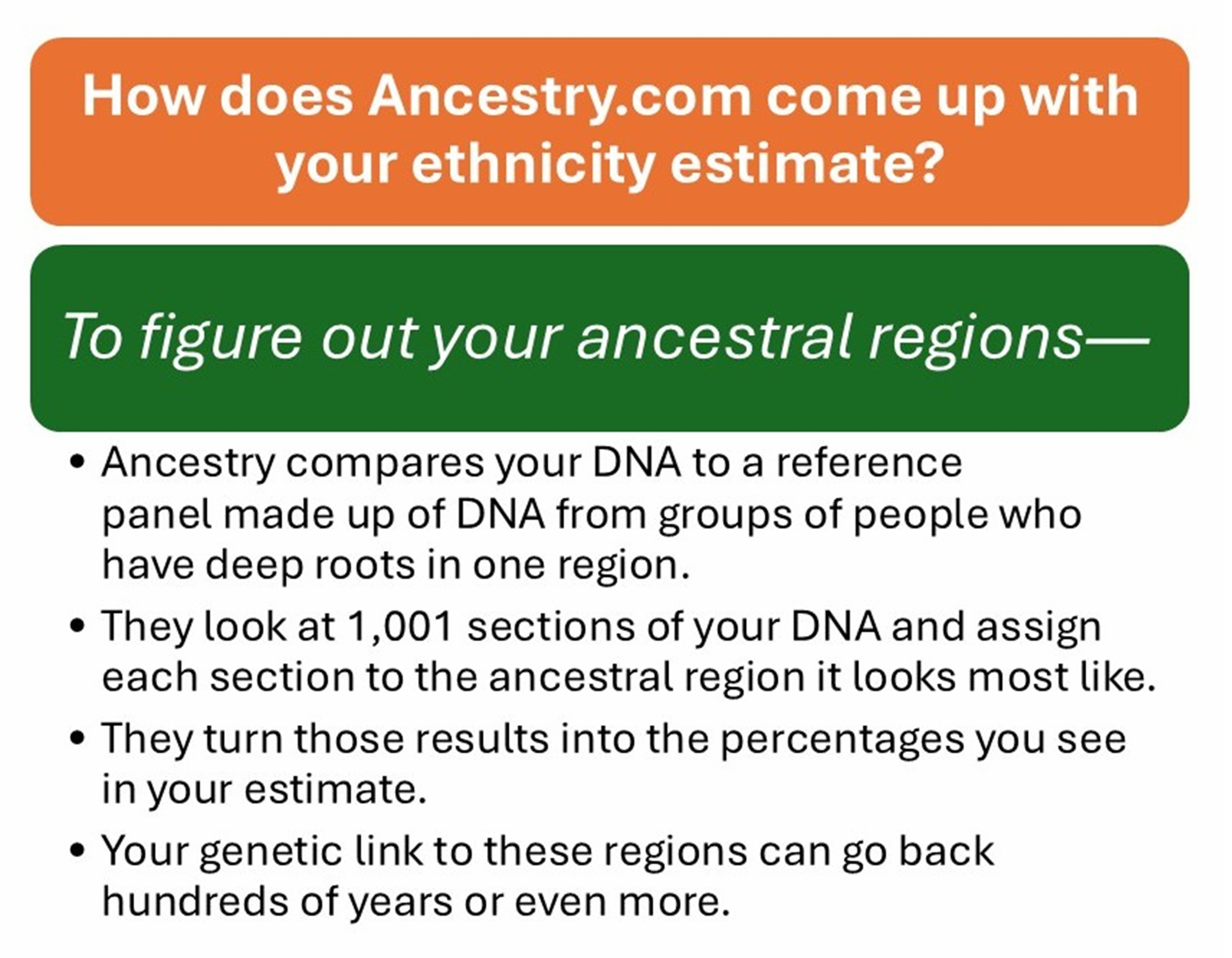
I can tell Karrie already feels a connection to these people. The closer we get to the answers, the more she needs and longs to know the truth. She’s settling into the reality of her ancestry. To clarify, she was never upset about the discovery of Jewish ancestry. Rather, she was stunned to think they had never known. And those feelings intensify with the reminder that her mother died not knowing anything of her history or meeting even one genetic relative other than her own children. As we wait for test results, I anticipate more conversations and deepening connections between Karrie and these new relatives.
I no sooner placed Judy’s parentage mystery on the “waiting shelf” than a Florida-born adoptee—where adult adoptees cannot access their original birth certificate—searching for her birth mother pinged my radar. Her Jewish ancestry estimate comes in at 77%, information that did not come as a surprise to her. Now I have something to keep me busy while we wait for Karrie’s new relatives to receive their DNA results.
Need suggestions on next steps for solving a family mystery? Have you received your DNA results and find yourself asking, “What now?” Drop me a message at bethsteury@gmail.com

